Last Case in the United States: 1949
Last Natural Case in the World: 1977
Last Case in the World: 1978 (Accidental Lab exposure: 1 death)
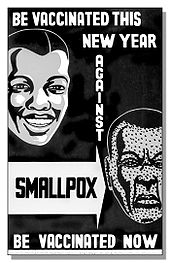
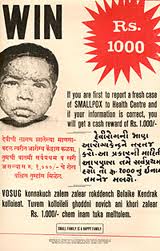
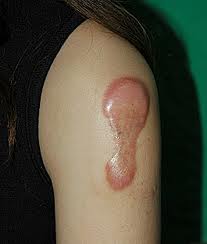
Smallpox or the Variola virus had a vaccine created against it in the 1960's. The vaccine derived from Vacinnia another virus that was extremely similar to the Variola virus. Today, only medical personnel that are trained with handling a Smallpox outbreak receive the vaccine. Unlike a shot, in which a needle is inserted into the skin and the vaccine is released in the bloodstream, the Smallpox vaccine is given differently. Instead, two needles are dipped in the vaccine and then used to prick the skin multiple times. Since Smallpox is similar to Vacinnia, a pustule will form at the "vaccination site". There are explicit directions on how to deal with the pustule healing process. If the vaccine is successful, then the patient is usually protected from the Smallpox virus for 3 to 5 years.
In 2011, The WHO (World Health Organization) held a convention discussing medical problems surrounding us today. A topic included in the convention was the destruction of the remaining controlled environments the smallpox virus lives in. In 1980, Multiple health centers across the world received the virus and were instructed to keep it dormant by storing it in liquid nitrogen. By 1984 the Soviet Union and the United States were the only countries that had the virus. It has been decided that the smallpox virus remain contained in the U.S. and Russia to allow testing that would allow for possible medical advancements to help with other diseases.

.jpg)
.jpg)